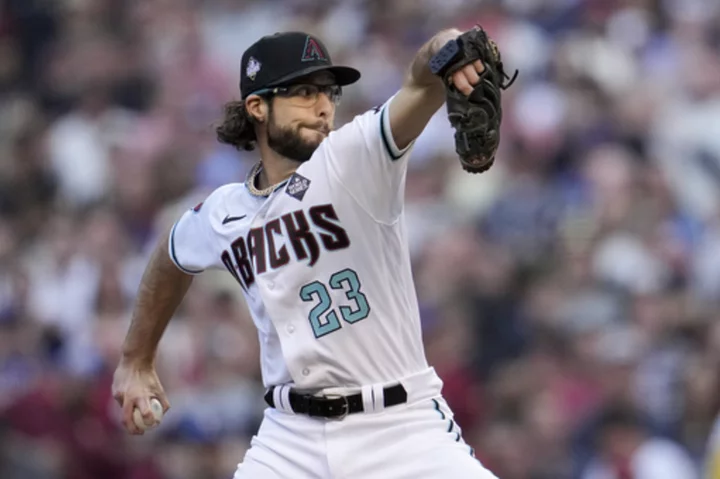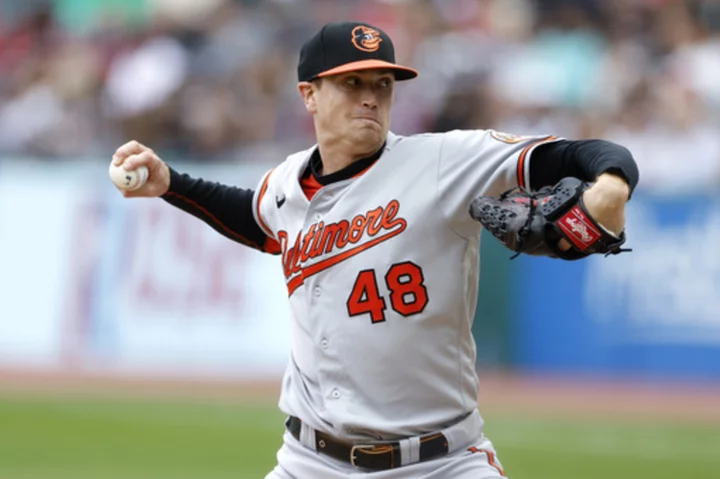
All the wrong moves: What Cardinals rotation could have looked like if front office didn't blow it
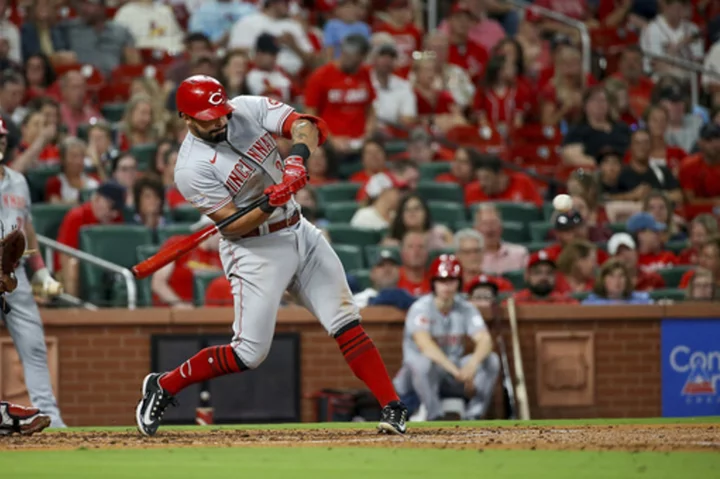
Can you imagine what the St. Louis Cardinals starting rotation would look like had some moves gone differently?The St. Louis Cardinals have made several questionable moves over the past few seasons. The most dubious move from John Mozeliak, Cards president of baseball operations, has come from t...
2023-05-22 04:49
Taylor Swift at MetLife Stadium to watch Travis Kelce's Chiefs take on the Jets
Taylor Swift couldn’t just shake off another chance to watch Travis Kelce on the football field
2023-10-02 08:17
Why is Man City vs Liverpool at 12:30pm? Kick-off time explained
Why Manchester City vs Liverpool will kick off at 12:30 GMT in Gameweek 13 of the 2023/24 Premier League.
2023-11-24 23:28
The story of Silvio Berlusconi and the birth of the Champions League
A version of this story was published in February 2017 Diego Maradona was one of many players struck by the strange “uniqueness” of the occasion. He wasn’t to know the half of it. Because, the last and only other time that Napoli travelled to Real Madrid - back in the 1987-88 European Cup - it involved a hugely bad-tempered game that also saw a manager call a player a “mafioso” and took place in front of no fans and in an odd silence, due to crowd trouble the previous season from Real’s infamous Ultrasurs. It was hardly the setting for such a highly anticipated match between two heavyweights, not to mention the meeting of one of the greatest players ever and the most successful European Cup club ever. All of that will likely get replayed in the build-up to Napoli’s return to the Bernabeu on Wednesday, but none of it is what really makes that 1987 match unique. This was actually the game that changed European football. AC Milan owner Silvio Berlusconi was one of many watching, but he couldn’t share in the excitement around the fixture. He was aghast at the fact that two clubs like that could meet as early as the first round of the competition, as was happening here. It was hardly the stage to waste such a highly anticipated clash, or to waste one of the sides that would be eliminated but instead should have been making the competition all the more enticing later on. Berlusconi naturally feared the same could happen to his own club, but also had wider concerns. So, he set in motion his plans for a European super league. That didn’t happen, but the idea - and the threat - directly led to the creation of the Champions League, and the super-club-dominated era we have today. It is also a situation with several levels of irony. What is only the second ever tie between Real and Napoli is now seen as a novelty in a last-16 stage that has meetings of Barcelona-PSG and Arsenal-Bayern Munich both being replayed for the fourth time in just five years, a level of repetition that has dulled some of the Champions League’s intrigue and mystique. It was exactly the intrigue and a mystique of a rarely-played fixture coming in the competition’s old opening knock-out round, however, that led to that. What’s more, this growth of the Champions League has someway cannibalised some of those who were initially so behind super league ideas - from Rangers in Scotland to Liverpool and even Milan themselves. It’s certainly difficult not to wonder what Berlusconi now thinks about Milan’s meek drift away from the glamorous competition he helped create. You don’t have to wonder what Real and Napoli thought on being drawn against each other so early in 1987, though. They were stunned. Part of the reason was that the first-time Italian champions had no European pedigree, so were unseeded. Real’s pedigree was emphasised by the fact this was their 100th European Cup match at the Bernabeu, making it all the more incongruous that it would take place in front of the stadium’s empty stands. A two-game closed-doors order was the price for crowd trouble in the previous season’s semi-final against Bayern Munich. It was probably oddly fitting that the match that would prove so transformative for the quality, glamour and scope of the competition, however, was a poor game played in front of nobody. Described by Mundo Deportivo at the time as a “cold” occasion where the players were “orphaned” on the pitch, it did heat up between the teams. Both squads probably took Maradona’s demand to “go and batter them!” a bit too literally. Many kicks and apparently punches were traded, a bag of ice was thrown at Real manager Leo Beenhakker, and Napoli’s Salvatore Bagni later claimed the Dutch coach and some of his players had called him “mafioso”. Beenhakker did apologise for that before the second leg, again citing the “unique” circumstances of the game, but from the vantage point of a 2-0 victory. The goals summed up the level of performance. Michel scored from a penalty, Fernando De Napoli was responsible for an own goal, all to the sound of silence. Returning to Spain for the first since leaving Barcelona in 1984, Maradona had been marked out of the game, and blamed Napoli’s poor display on the pressure of a first appearance in the competition. “You don’t have to exaggerate,” he said. “We did not see the true Napoli, perhaps because of the responsibility of a debut in the European Cup.” It was exactly this kind of quirk, however, that so concerned Berlusconi. He just couldn’t see the logic in the competition’s best - and most televisually lucrative - teams potentially going out because of one bad night, one stroke of bad luck. It was precisely this Berlusconi feared for Milan, as he admitted in what would prove a hugely prescient interview with World Soccer in 1991. Amid predictions about the decline of international football and how European Union regulations would completely condition the continental game, the mogul came out with the following: “The European Cup has become a historical anachronism. It is economic nonsense that a club such as Milan might be eliminated in the first round. It is not modern thinking.” Berlusconi had shown a lot of very modern thinking, particularly by football’s conservative standards, since taking over Milan in 1986. Though always a fan of the club, he saw them as one arm of his business empire. Berlusconi made little secret of his plans to use both the Rossoneri brand and his media company Mediaset together to maximise both. Having already revolutionised broadcasting in Italy with the way his innovative approach to regional stations evolved into the country’s first national private TV station in Canale 5, he had similar plans for football. Berlusconi felt the sport was utterly wasting its potential in this area, and not at all reaching a potential pay-TV audience of millions and beyond. He thought it absurd that the biggest clubs in a sport that involved so many popular stadium events were not regularly meeting in glamorously lucrative matches. Martin Schoots is now a prominent European agent representing players such as Christian Eriksen, but was then a journalist primarily covering the three Dutch stars at Milan - Marco van Basten, Ruud Gullit and Frank Rijkaard - and was always impressed with Berlusconi’s approach when they met. “He was a visionary,” Schoots says,” and very clear and convinced about what developments would come. His philosophy was that football was a spectacle.” Or, as was put by some of those close to Berlusconi, “the television spectacular world-wide” - and the potential audience for his Canale 5. Making the European Cup a super league was not quite a new idea, though. That had actually been creator Gabriel Hanot’s initial plan for the competition in 1955 in order to better reflect “rightful” champions than the nuances of knock-out football, but proved impractical with the travel and communication of the time. Liverpool had also come up with a discussion document suggesting mini-leagues in 1978, around the time they were drawn against Nottingham Forest in the first round, and that had been revived in 1984. No-one, however, had gone for it with the same force or sense of structure to it as Berlusconi. this Super League was based on merit, tradition and television - and therefore it was a league for big television markets Alex Flynn After initial moves with Real president Ramon Mendoza were rejected, the Italian businessman decided to commission a blueprint for a ‘European Television League’ in 1988. The man who ended up with that commission was Alex Fynn, then of Saatchi and Saatchi. A huge football supporter, Fynn had already given a talk at an event for the Rothman’s Football Yearbook called a ’10-point blueprint for football’, suggesting exactly a European super league. It was subsequently printed in the Times, and word got around. “A few weeks later, I got a call from the head of our Italian agency,” Fynn tells The Independent now. “He said ‘here’s the job you always wanted: design a super league for Berlusconi.’ And the reaction? “My reaction? My reaction was my head was turned, I was flattered, and I did what I thought he wanted - not necessarily what football needed. So this Super League was based on merit, tradition and television - and therefore it was a league for big television markets. I think it had a league of about 18 clubs and certainly two each from England, Italy, Spain… that was the plan.” It was a plan initially rejected by Uefa, but had still done its job. The idea was out there, as was the underlying threat of a possible breakaway and possible changes were now on the table. “He decided to publicise it and use it as a stalking horse and catalyst to support his argument,” Fynn says of Berlusconi. “I think it went further than that. When someone like Berlusconi has a plan for a breakaway European super league, even Uefa had to sit up and take notice. The underlying threat was this businessman might have the wherewithal to do what he says. In theory, breakaways aren’t tangible, because they need the sanctioning of Uefa and Fifa. So maybe he realised that and maybe all he was doing was to produce the plan to affect some sort of change that would benefit his club and his commercial business - which of course it did.” Uefa fundamentally realised the dilemma between trying to keep the big clubs happy and keeping their structures intact, and thereby had to strike a balance, setting a dynamic that would lead to the current situation - but keep tilting one way. In the autumn of 1991, at an extraordinary Uefa congress, the then 35 members voted in new proposals, this time primarily put drawn up by Mendoza and former Rangers secretary Campbell Ogilvie. The quarter-finals would be replaced by a group stage, and league systems would be part of the competition for the first time. Even more important than that structural change, though, Uefa contracted the marketing company TEAM to sell it. The competition would the next season become the Champions League - to create what Fynn describes one of international sport’s two “supreme branded events” along with the NFL, right down to the distinctive classical anthem - an exclusive ‘family’ of corporate sponsors were signed up, and TV packages would be sold to the highest bidder, based on market share. Big clubs from the leagues with the largest TV markets would earn more and more money, accumulating more and more political capital Crucially, Berlusconi’s broadcasting model had properly permeated club football for the first time. The European game’s governing body had adopted many of its principles, as would the Premier League and many of the continents major clubs, bringing huge finances into the game - but also greater disparities than ever before. Big clubs from the leagues with the largest TV markets would naturally earn more and more money, accumulating more and more political capital, to the point more and more changes to the Champions League were inevitable. Finally, with two of this week’s fixtures offering the clearest examples in Barca-PSG and Arsenal-Bayern, we have the regular “television spectaculars” Berlusconi so envisaged. He probably didn’t envisage them, however, without Milan. That team he created, however, might still be the most influential in history. Because, just as they were changing football on the pitch with Arrigo Sacchi’s tactical ideas, the club were also changing football off it through Berlusconi’s economic ideas. And, if it was fitting that the first leg of the Real-Napoli tie was so off-putting given the change that would follow, it was equally fitting the return would give a sign of what was to come; what was capable - both in terms of the event, and the takings. This truly was the “television spectacular” Berlusconi desired. In front of a raucous 82,231 crowd at Napoli’s San Paolo stadium, and with Brazilian star Careca back in the team after injury, the revenge-driven home side finally did what Maradona demanded and “battered” Real in the right way. If only for 44 enticingly intense minutes. That Real team never got beyond the semi-finals, and were the very next season hammered 5-0 by Milan in a historic landmark of a game Defender Giovanni Francini had set the occasion alight by making it 2-1 after just after the half-hour, and Napoli could have added many more before Careca - of all people - missed a fine chance on 40. Within four minutes, Emilio Butragueno had scored the decisive goal. Real were through. If history regularly repeats itself, it’s interesting how so many of the same debates do, too. In the aftermath of that game, Maradona’s European pedigree was questioned, while Butragueno’s clinical brilliance was widely praised. Neither would actually end up winning the European Cup, as that Real team never got beyond the semi-finals, and were the very next season hammered 5-0 by Milan in a historic landmark of a game. At the time, though, Real were convinced they were on the brink. They even celebrated that victory in an unusually ostentatious manner. Beenhakker was remarkably moved to declare a mere first-round win - for a club that had then won the competition six times - as “a result for history”. It was to prove exactly that, but not in the way he imagined. The future could already be imagined from Napoli’s earnings from the game. They received 10,000 million lira due to both ticket and television sales, estimated at that point to be a world record. The die had been cast - and is still rolling. The Champions League continues to gradually change according to the preferences of big clubs, if at a somewhat glacial pace. “The big clubs never have enough money,” Fynn says. “That’s why you can never satisfy them, whatever changes you make.” Right now, what generally happens is that we see a lot of the same clubs, and a lot of the same fixtures in the latter stages of the competition - to the point Real and Napoli is again a novelty. It is thereby a fixture that will forever remain unique. Read More Pep’s future and Premier League charges – Where next for Man City after treble? How Pep Guardiola can become the undisputed greatest manager Man City fans feel let down by Uefa’s ‘shambolic’ organisation of Istanbul final Football rumours: Wilfried Zaha eyes move to Paris St Germain The sporting weekend in pictures Pretty Woman makes Pep Guardiola’s day as Julia Roberts hails Man City champions
2023-06-12 18:59
Burrow and the Bengals hope to win back-to-back games when they host the Seattle Seahawks
Joe Burrow’s calf injury has healed enough that the young quarterback was scrambling and throwing downfield again Sunday in the Bengals' 34-20 win over Arizona
2023-10-13 05:52
Jeremie Frimpong signs new contract at Bayer Leverkusen through 2028
Dutch right back Jeremie Frimpong has signed a new contract at Bayer Leverkusen taking him through the end of the 2027-28 season
2023-10-03 19:23
Cubs rumors: Pitcher extension, Japanese FA target, Bellinger replacement idea
In today's Cubs rumors, Chicago looks to extend Kyle Hendricks, a Japanese star boosts the bullpen, and Cody Bellinger's replacement options get revealed.
2023-10-23 23:59
African players in Europe: 'Exceptional' Salah reaches 200 goals
Egypt captain Mohamed Salah reached 200 goals in English football with a double in second-placed Liverpool's 3-0 win against...
2023-11-13 20:24
Argentina beats Brazil 1-0 in World Cup qualifying after crowd violence delays start
Many fans went to the Maracana Stadium to watch Lionel Messi in his likely last match in Brazil, a superclasico in World Cup qualifying against the hosts
2023-11-22 11:59
D-backs become buyers at trade deadline, add Mariners closer Paul Sewald in exchange for 3 players
The Arizona Diamondbacks are working on a trade to solidify the back of their bullpen for the stretch run, acquiring closer Paul Sewald from the Seattle Mariners in exchange for infielder Josh Rojas, outfielder Dominic Canzone and minor leaguer Ryan Bliss, according to a person familiar with the deal
2023-08-01 06:24
Ziegler surges from fifth to first with a near-flawless free skate to win the NHK Trophy
Ava Marie Ziegler has performed a near-flawless free skate to win the NHK Trophy and lead a U.S. 1-2 finish on the podium
2023-11-25 16:15
Dele Alli reveals childhood drug dealing, sexual abuse and sleeping pill addiction
Dele Alli has revealed he was sexually abused at the age of six and was dealing drugs two years later – while a recent fight against a sleeping pill addiction led to a six-week stay at a rehab clinic. The Everton midfielder has seen his football career stall in recent seasons but has now spoken on the reasons behind a mental health battle that saw him contemplate hanging up his boots at the age of 24. In an emotional interview, the Everton midfielder and former England international fought back tears as he laid bare his difficult upbringing before he was adopted by the Hickford family. Alli also told Gary Neville in The Overlap podcast, in partnership with Sky Bet, that he only came out of rehab last month as he struggled with his mental health. The 37-cap England star, who spent last season on loan at Turkish side Besiktas, said: “When I came back from Turkey, I came in and I found out that I need an operation and I was in a bad place mentally. “I decided to go to like a modern-day rehab facility for mental health. They deal with like addiction, mental health, and trauma because it was something that I felt like it was time for. “I think with things like that, you can’t be told to go there. I think you have to know, and you have to make the decision yourself, otherwise it’s not going to work.” Alli – a key part of the England side that reached the 2018 World Cup semi-finals – also laid bare the sickening abuse he received as a child, saying he was “molested” at the age of six. “(Childhood) is something I haven’t really spoken about that much, to be honest,” he said. “I was sent to Africa (to stay with his father) to learn discipline, and then I was sent back“At seven, I started smoking, eight I started dealing drugs. “An older person told me that they wouldn’t stop a kid on a bike, so I rode around with my football, and then underneath I’d have the drugs, that was eight. Eleven, I was hung off a bridge by a guy from the next estate, a man. “Twelve, I was adopted – and from then, it was like – I was adopted by an amazing family like I said, I couldn’t have asked for better people to do what they’d done for me. If God created people, it was them. “There were a number of times my adopted family and my brother – you know, it makes me sad – they would take me to rooms crying, asking me to just speak to them, tell them what I’m thinking, how I’m feeling, and I just couldn’t do it because I wanted to deal with it by myself.” After signing for Tottenham from MK Dons, Alli enjoyed a fine run of form that culminated in playing a key role in England’s progress to the World Cup semi-finals in 2018. But he was still battling in silence off the pitch – leading to a “scary” addiction to sleeping pills and a reliance on alcohol. “I got addicted to sleeping tablets and it’s probably a problem that not only I have, I think it’s something that’s going around more than people realise in football,” he said. “I think, without me realising it – the things I was doing to numb the feelings I had...I didn’t realise I was doing it for that purpose, whether it be drinking or whatever. “I don’t want to talk about numbers but it was definitely way too much, and there were some scary moments I had. “To take a sleeping tablet and be ready for the next day is fine, but when you’re broken as I am, it can obviously have the reverse effect because it does work for the problems you want to deal with. “That is the problem – it works until it doesn’t. So yes, I definitely abused them too much. It is scary, now I’m out of it and I look back on it. “Probably the saddest moment for me, was when (Jose) Mourinho was (Tottenham) manager, I think I was 24. I remember there was one session, like one morning I woke up and I had to go to training – this is when he’d stopped playing me – and I was in a bad place. “I mean it sounds dramatic but I was literally staring in the mirror – and I was asking if I could retire now, at 24, doing the thing I love. For me, that was heart-breaking to even have had that thought at 24, to want to retire. That hurt me a lot, that was another thing that I had to carry.” Alli said that he had largely been able to mask his difficulties during his football career but to the detriment of his mental health. He added: “To be honest, I was caught in a bad cycle. I was relying on things that were doing me harm and, yeah, I think I was waking up every day and I was winning the fight, you know, going into training, smiling, showing that I was happy. “But inside, I was definitely losing the battle and it was time for me to change it because when I got injured and they told me I needed surgery, I could feel the feelings I had when the cycle begins and I didn’t want it to happen anymore. “So, I went there [rehab], I went there for six weeks and Everton were amazing about it, you know. They supported me 100 per cent and I’ll be grateful to them forever.” Dele Alli was speaking to Gary Neville on a special episode of The Overlap in partnership with Sky Bet. Read More The inspiration behind Australia’s shot at home World Cup glory Women’s World Cup history hangs over co-hosts New Zealand Jordan Henderson offered quadruple his Liverpool wages to join Gerrard’s Saudi side The inspiration behind Australia’s shot at home World Cup glory Women’s World Cup history hangs over co-hosts New Zealand Jordan Henderson offered quadruple his Liverpool wages to join Gerrard’s Saudi side
2023-07-13 18:47
You Might Like...
65-year-old Bernhard Langer wins the US Senior Open to break the Champions’ victory record
Brian Burns' status for Panthers opener against Falcons uncertain because of contract dispute
Count on Swinney's steadiness to build back stumbling Tigers
Giants skipper Kapler to serve 1-game suspension for returning to dugout after being ejected
Bayern Munich confirms initial talks around reported Sadio Mané move to Saudi Arabia
Her Game Too is making sure soccer fandom is safe for everyone
Bournemouth facing anxious wait over Dominic Solanke’s ankle injury
England suffer Ashes blow as Pope sidelined for rest of series